
Science talks at PlantBank
Science Symposium
“Spare a thought for the Trees”
10 – 1 pm Wednesday 8th February 2023
| Time | Presenter | Title |
| 9:30 | Welcome Tea | |
| 10:00 | Brett Summerell | An introduction to the conservation impacts of Myrtle Rust in Australia |
| 10:20 | Karen Sommerville | Ex situ collections for research and recovery |
| 10:40 | Michelle Moffitt | Metabolomics for the identification of resistant plants |
| 11:00 | Peri Tobias | Developing tools to manage myrtle rust with remote monitoring and strain diagnostics |
| 11:20 | Morning Tea | |
| 11:40 | Jason Bragg | Conserving plants that are impacted by myrtle rust: preserving diversity and promoting resistance |
| 12:00 | Amelia Yenson | Safe Custody for Native Guava – a pilot project for capturing and sharing plant material |
| 12:20 | Alyssa Martino | Gum Tree Guardians; monitoring the spread of myrtle rust in Australia |
| 12:40 | Robert Makinson | More than the sum of the parts – some thoughts on national needs and strategy |
| 1:00 | Networking | (Lunch not provided ☹ but available at the Gardens) |
@Australian PlantBank
The Australian Botanic Garden
362 Narellan Road
Mount Annan 2567
Myrtle Rust
Myrtle rust is a fungal disease that affects plants in the family Myrtaceae, which includes a wide range of economically and ecologically important plants, such as eucalyptus, tea trees, and bottle brushes. It is caused by the fungus Austropuccinia psidii, which is native to South America and was first detected in Australia in 2010.
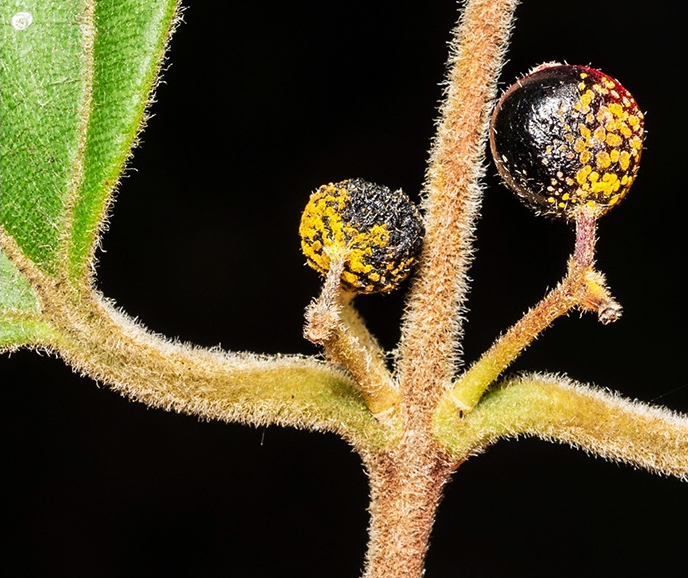
Myrtle rust causes yellow or orange pustules to appear on the leaves, stems, and flowers of infected plants. These pustules can lead to leaf loss, reduced growth and vigor, and, in severe cases, plant death.
The long-term ecological impacts of myrtle rust on Australian native plant communities are not yet fully understood, but the disease has the potential to significantly alter the structure and function of these communities. Scientists and land managers are working to understand the disease and develop strategies to mitigate its impacts on native plants.
The fungus has a complex life cycle, with multiple spore stages that are dispersed by wind and water. It can also be spread by the movement of infected plants or plant material.
Scrub turpentine (Rhodamnia rubescens) is a rainforest tree which grows to 25m tall, with reddish-brown, stringy bark, triple-veined leaves, small (8mm) white fragrant flowers and fleshy berries (7mm) turning black when mature.
The Royal Botanic Gardens Sydney and the Australian PlantBank facility are working to establish an emergency collection of seeds and plant material, which will be used for important research into disease resistance and breeding.
Science Links
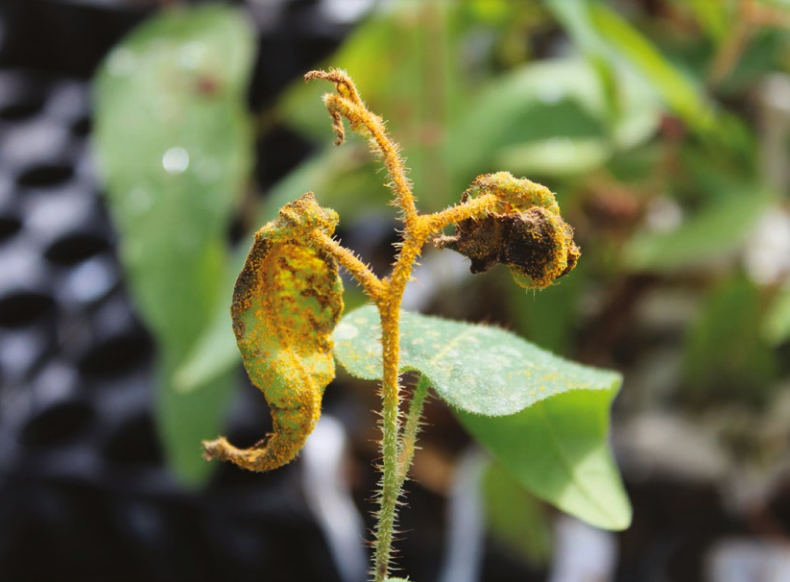
Image:
Spotted Gum (Corymbia maculata)
infected with Myrtle Rust in glasshouse screening program
Credit:
Geoff Pegg
Queensland Department of Agriculture and Fisheries
Where is PlantBank at Mt Annan Botanical Gardens?
The Plant Bank and the Australian Botanic Gardens are located in south-western Sydney at Mount Annan near Campbelltown. The garden. It is the largest botanic garden in Australia, consisting of 30ha of cultivated displays in a native bushland setting. The Garden has a range of picnic areas and over 20 kilometres (12 mi) of walking tracks and is home to the Australian PlantBank – a centre of excellence in plant science.
PlantBank is approx. 1 hour drive from the inner-west of Sydney.
Follow M5 and Hume Motorway/M31 to Narellan Rd/A9 in Campbelltown.
Take the Narellan Rd/A9 exit from Hume Motorway/M31
Continue on Narellan Rd/A9. Drive to Cunningham Dr in Mount Annan
Parking is available at parking bays outside PlantBank
 The Art and Science of Myrtle Rust