
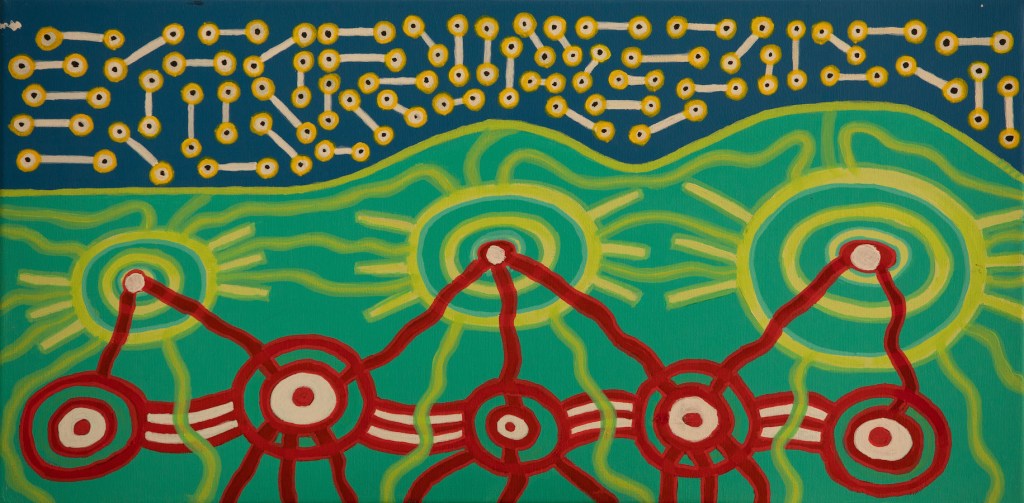
Like a thief in the night
I wanted this piece to talk about the complexity of reactions, relationships and mechanisms taking place continuously all around us without us even realising.
These reactions, partnerships, chains of events and the symptoms of these cycles and the outcomes of this array of complexities are the foundations of our natural environment.
It’s extremely complex but surprisingly simple all at the same moment in time.
Each environment is different, yet each ecosystem shares components, actors and mechanisms within it, a commonality.
These actors are sometimes interchangeable on occasion but these interchangeable characteristics do not ensure balance, in fact they bring about an imbalance and with that comes rapid change.
These foreign interchangeable actors have devastating impacts “like a thief in the night”
Artist:
Darren Charlwood
Art Medium:
Acrylic on canvas
31 x 61 cm
$500
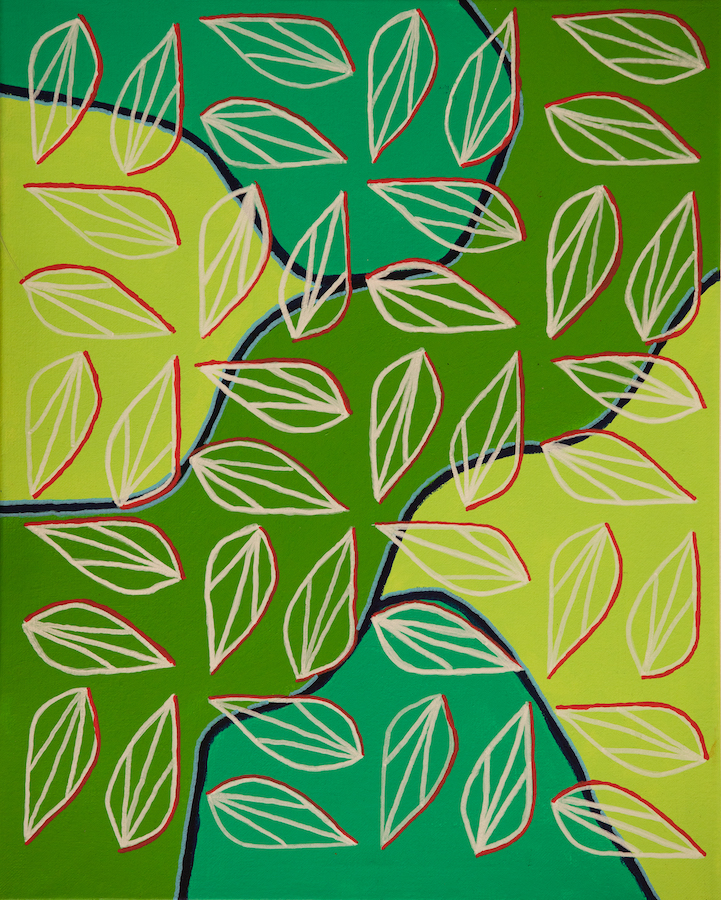
Change
I used a repeating leaf pattern in this painting in the traditions of Aboriginal cultural art where generations of artists use the designs of their ancestors.
In repeating these patterns we reaffirm these traditions, honouring our ancestors, becoming conduits for our shared identity and expressing our identity through art.
But it’s changed and I represented this change by putting red throughout the pattern on the leaves, the rust.
The leaves are also like skeletons, hollow representations of what once was.
On a background of surrounding green they subtly stand out.
Change is constant, in fact the one consistent rule that can be applied to science as well as the natural world but these changes are slow and consistent allowing for adaptation.
When change occurs rapidly it has devastating consequences.
Artist:
Darren Charlwood
Art Medium:
Acrylic on canvas
51 x 41 cm
$500
Darren Charlwood

Darren was born in Sydney’s Inner West and grew up in Redfern surrounded by the newly empowered Aboriginal community in the 1980s. He is a Wiradjuri man from the yabaay wagaan (wedge tail eagle and crow) mob in Wellington.
Darren began painting at a young age; however, it was not until 10 years ago that he began painting full time.
Darren’s art is deeply rooted in his experience as a Wiradjuri man, a father, a son and a member of the urban Aboriginal community of Sydney’s Inner West. He also draws heavily from his cultural knowledge of the environment and the Wiradjuri use of lines and patterns.
Within the urban context, Darren produces pieces which reflect his environment. He makes use of recycled materials which come from the environment, something which is based on the Aboriginal tradition of using only what is needed from the environment.
Darren’s work is his expression of Aboriginality and reflects his political perspectives in the resistance of Aboriginal people against colonial oppression and dispossession. His art reflects the survival and adaptation of his people when faced with invasion and the sudden and violent change to their environment which came with it. The continuation of cultural practice is a protest in itself, as reflected in the endurance of the voices of Aboriginal people in Australia.
 The Art and Science of Myrtle Rust